
PG1 - The Sophomore - Part II: The Leap

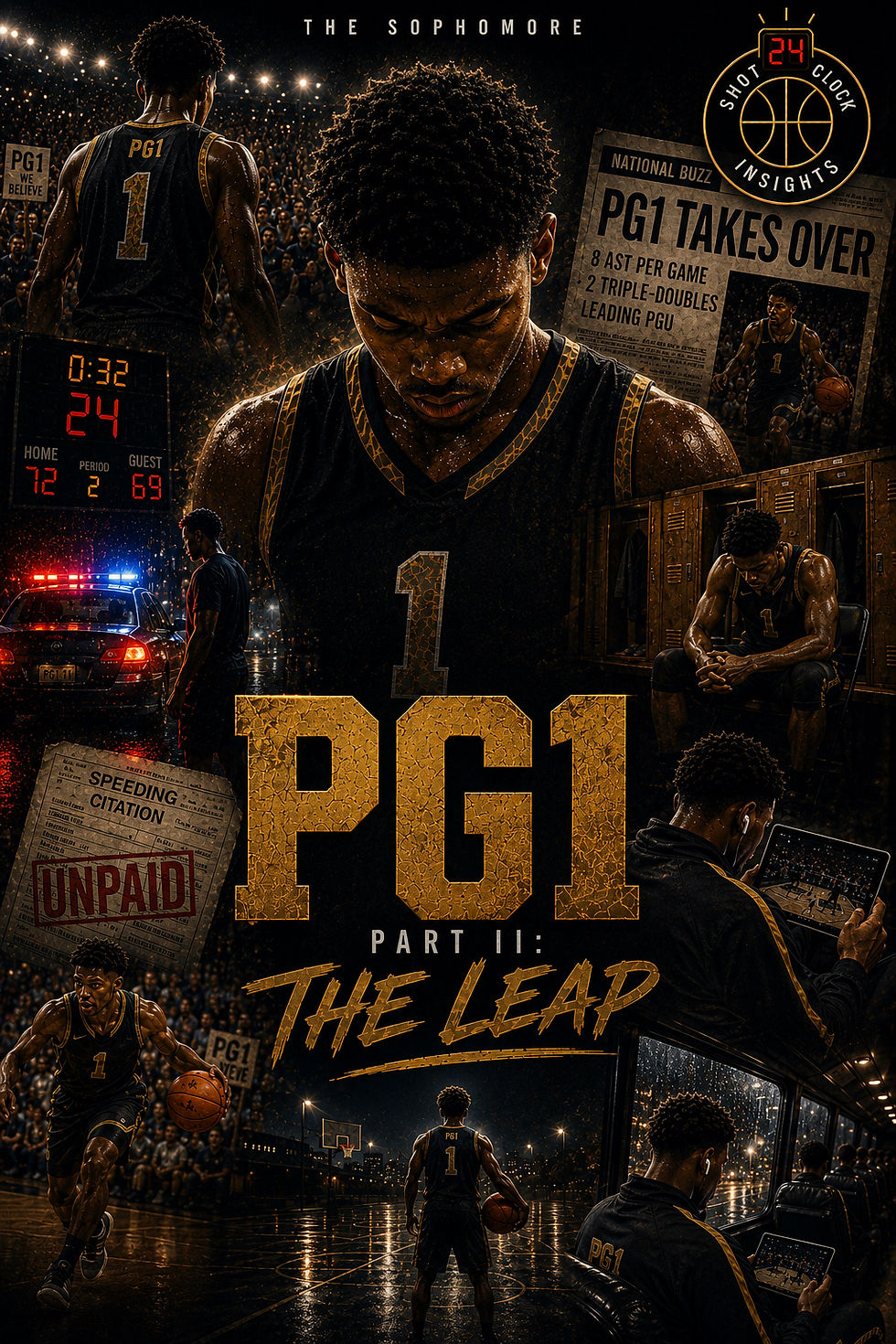
The game slowed down for Bobby, but his life did not. If anything, everything around him started moving faster. Practices felt faster. Decisions came faster. Expectations grew faster. Recognition spread faster. For the first time since arriving at PG University, people outside of campus were beginning to notice what was happening.
At first, the attention came quietly.
It lived in conversations between assistant coaches before games. It showed up in social media clips with captions like, “This guard is tough,” or, “PG1 really took a leap.” Scouts started appearing behind the baseline during warmups with notebooks resting on their laps. Basketball pages began posting highlights of Bobby controlling games, threading passes through traffic, and making reads most guards his age could not make.
The whispers slowly turned into real conversations.
“Who is this kid?”
“He got way better.”
“He running the whole team now.”
“The game really slowed down for him.”
Bobby heard all of it eventually, but he never allowed himself to get distracted by it. He did not play for attention. He played because he genuinely loved the process of becoming better. Every early morning workout, every late-night film session, every empty gym rep during the summer was beginning to show itself during the season.
The leap became impossible to ignore.
His numbers jumped across the board. He averaged eight assists a game while controlling the pace better than almost anybody in the conference. Some nights he scored twenty without forcing a shot. Other nights he barely looked at the basket but completely controlled the game through decision-making and tempo.
Then the triple-doubles started happening.
The first one came during a conference game against a smaller school that nobody expected PG University to struggle with. Bobby finished the night with 18 points, 11 assists, and 10 rebounds, but he did not even realize it until a reporter mentioned it afterward.
“You know you had a triple-double tonight?” the reporter asked while holding a recorder toward him.
Bobby looked genuinely confused for a second.
“For real?” he said.
Everybody around him laughed.
That was the scary part about his improvement. He was not chasing numbers. He was simply playing the game the right way, and the numbers naturally followed.
The second triple-double felt different.
That one created noise nationally.
Sports pages clipped his passes and posted captions calling him one of the most improved guards in the country. Analysts mentioned him during halftime shows. Small basketball blogs started writing articles about his growth from freshman year to sophomore year.
“Big leap from PG1.”
“One of the smartest young point guards in the country.”
“He controls the game like an older player.”
The attention kept growing, but Bobby stayed locked into the same routine that got him there. Practice. Film. Games. Improvement. Repeat.
That was all he cared about.
But while his game became more disciplined, his life off the court did not.
The problems started small.
Bobby drove fast everywhere. He drove fast to practice. Fast to class. Fast back to campus after road trips. His entire life felt rushed now, and eventually that started catching up to him.
The first speeding ticket ended up shoved inside the glove compartment of his car.
The second ticket stayed folded in the passenger seat for almost two weeks.
The third ticket never even made it home.
Bobby crumpled it up and threw it away at a gas station.
“They just want money anyway,” he told one of his teammates while standing beside the pump.
“You gonna pay them?” the teammate asked.
“I’ll get to it,” Bobby responded.
But he never did.
Deep down, Bobby honestly believed the tickets would eventually disappear if he ignored them long enough. He did not fully understand how serious it could become. He was nineteen years old, moving fast, playing the best basketball of his life, and thinking more about the next game than real-life responsibilities.
But real life does not stop just because basketball is going well.
One night after a road win, Bobby got pulled over again while driving back to campus.
This time was different.
The officer returned to the car with a completely different tone in his voice.
“You got multiple unpaid citations,” he said while shining the flashlight into the car. “Your license is suspended.”
Bobby felt his stomach drop instantly.
He tightened both hands around the steering wheel and stared straight ahead through the windshield. For the first time all season, he felt completely stuck.
Because suddenly this situation was bigger than basketball.
Word spread around campus faster than he expected. By the next afternoon, Coach already knew everything.
Walking into the coach’s office felt heavier than any conditioning workout Bobby had ever experienced.
Coach sat behind the desk quietly for a moment before finally speaking.
“You wanna explain this to me?”
Bobby rubbed his hands together nervously before answering. Three speeding tickets. Unpaid fines. Suspended license. Multiple times getting pulled over.
Every sentence sounded worse once it was said out loud.
Coach leaned back in his chair and shook his head slowly.
“You know what makes this frustrating?” he said. “You’re playing the best basketball of your life right now, and you’re moving like somebody trying to lose everything.”
Bobby lowered his eyes toward the floor because deep down, he knew Coach was right.
The suspension came immediately.
Two games.
Team violation.
No arguments.
No exceptions.
When the news broke publicly, everybody suddenly had opinions.
“That suspension weak.”
“It’s just speeding tickets.”
“Coach doing too much.”
But Coach did not care about outside opinions, and honestly, neither did Bobby.
The embarrassment already hurt more than the punishment itself.
For the first time all season, Bobby had to sit still while everybody else played.
That part destroyed him.
During the first suspended game, Bobby sat quietly at the end of the bench while the team warmed up around him. Normally he would have been controlling the pace of warmups, talking during drills, preparing mentally for the opening tip.
Now he could only watch.
Watching the game from the sideline changed everything.
Every turnover stood out more.
Every missed read became obvious.
Every moment where the team looked rushed or disorganized felt louder.
“You seeing this?” one assistant coach whispered beside him during the second half.
Bobby nodded slowly.
Because he saw all of it.
He saw the bad spacing. He saw the hesitation. He saw moments where he normally would have calmed things down or controlled the tempo differently.
PG University lost the game by seven points.
The second suspended game went even worse.
Meanwhile, the national conversations started shifting.
One week people praised him.
The next week people questioned him.
“He immature.”
“Can he handle responsibility?”
“Bad off-court decision making.”
Funny how quickly people switch once success gets interrupted.
Bobby heard everything people were saying, but instead of getting angry, he became quieter. That usually meant he was locking in harder than ever.
The night before his suspension ended, Bobby stayed alone inside the practice gym long after midnight.
No music played through the speakers.
No teammates were around.
No cameras existed to capture the moment.
Just him.
He ran suicides until his legs burned. Then he picked up a basketball and started shooting. After that, he sat down and watched film for almost an hour before getting back up to shoot again.
Because as frustrating as the suspension felt, Bobby finally understood something important.
Success was not only about controlling the game on the court anymore.
It was also about controlling himself away from it.
The next morning, Bobby arrived at practice before everybody else.
Earlier than the managers.
Earlier than the assistant coaches.
Earlier than Coach.
The gym lights were still half off when he walked in.
He sat in the locker room for a minute quietly lacing his shoes before finally standing up and walking onto the court alone.
The sound of the ball echoing through the empty gym felt different that morning.
More personal.
More honest.
He started with simple ball-handling drills. Nothing flashy. Just movement. Rhythm. Pace. Sweat slowly formed across his forehead while the rest of campus was still asleep.
Eventually Coach walked into the gym holding a cup of coffee.
He stopped for a second watching Bobby work.
Neither one of them spoke immediately.
Coach simply nodded once before walking toward his office.
That nod meant more to Bobby than any speech could have.
It meant the mistake did not define him.
His response would.
When Bobby returned from suspension, the energy inside the arena immediately felt different.
The crowd got louder during introductions. Teammates slapped his chest harder during warmups. Fans stood longer when his name got announced.
Not because he was perfect.
Because everybody wanted to see how he would respond.
That mattered more.
Early in the game, Bobby pushed the ball up the floor during transition while the defender backpedaled in front of him. The crowd rose to its feet expecting him to attack immediately.
A few months earlier, he probably would have forced the play.
This time he slowed down.
He read the defense.
The help defender stepped too far inside, so Bobby fired a pass to the trailing shooter.
Splash.
Three points.
Next possession, he manipulated the pick-and-roll perfectly and threw a lob pass at the exact right moment.
Then another assist came.
Then another.
No forcing.
No rushing.
Just complete control.
By halftime, Bobby already had nine assists.
By the end of the game, he finished with 16 points, 14 assists, and 8 rebounds.
PG University won by eighteen.
As Bobby walked toward the locker room tunnel after the game, fans leaned over the railings trying to get his attention.
“PG1!”
“You back!”
“Keep going!”
He acknowledged them quickly before disappearing into the tunnel.
Inside the locker room, teammates celebrated loudly around him, but Bobby stayed calm.
One teammate walked over and slapped him on the shoulder.
“Boy, you different now.”
Bobby smiled slightly but did not answer.
Because deep down, he still felt like he had another level to reach.
That became the scariest part about his growth.
He no longer played emotional basketball.
Freshman-year Bobby used to react to everything. Bad calls. Missed shots. Turnovers. Crowd noise. Momentum swings.
Now?
He stayed steady.
That calmness started spreading throughout the team too.
When games became chaotic, teammates looked toward Bobby naturally. Not because he yelled the loudest, but because he looked the calmest.
That is what real point guards do.
They settle storms.
As conference play continued, national attention kept growing stronger.
Sports debates started mentioning his name regularly. Bigger programs came scouting games. NBA conversations slowly started appearing online.
Not serious conversations yet.
Just whispers.
“Undersized but skilled.”
“Elite pace.”
“High IQ.”
“Natural leader.”
Bobby saw some of it online late at night but tried not to focus on it too much.
Because one thing Coach constantly preached stayed stuck in his head:
“Attention can make you comfortable if you let it.”
Bobby refused to let comfort ruin him.
One road trip late in the season proved that.
The team had just landed after a tough loss where Bobby struggled badly. He turned the ball over six times and forced shots he normally never would have taken.
Reporters questioned whether fatigue was finally catching up to him.
Social media switched up again.
“He been forcing lately.”
“He not the same.”
“Teams figured him out.”
The noise never stopped.
That night, while most of the team relaxed inside the hotel, Bobby sat alone in his room watching film.
Again.
Pause.
Rewind.
Watch.
Pause again.
He replayed every turnover until he understood exactly why it happened.
Too fast there.
Missed the weak-side help there.
Forced that pass.
Should have slowed down.
Around two in the morning, his roommate finally looked over from the other bed.
“You ever stop thinking about basketball?” he asked.
Bobby stared at the screen for a second before answering.
“I ain’t got time to.”
The roommate laughed quietly and rolled back over.
But Bobby was serious.
Because basketball stopped feeling like something he did.
It became who he was becoming.
That was the real leap.
Not the stats.
Not the headlines.
Not the triple-doubles.
The real leap was the discipline.
The maturity.
The understanding that greatness lived in details nobody celebrated.
The next day at practice, Bobby looked sharper already.
Mistakes corrected.
Reads quicker.
Decisions cleaner.
Coach noticed it immediately.
“That’s growth,” he said quietly during film session.
Bobby did not respond.
He just kept watching the screen.
Still studying.
Still learning.
Still chasing more.
Later that night, the team bus rolled quietly down the dark highway while rain tapped softly against the windows.
Most of the team was asleep.
Bobby was not.
He sat near the window with his headphones on and film already loaded on his phone.
Possession by possession.
Mistake by mistake.
Read by read.
The same routine.
The same hunger.
Because the leap was never just basketball.
It was maturity.
It was discipline.
It was understanding that talent might open doors, but habits determine how long those doors stay open.
Outside the window, city lights blurred through the rain as the bus continued moving through the night.
Inside the bus, Bobby leaned forward and replayed another possession on his screen.
Pause.
Rewind.
Play again.
Still learning.
Still growing.
Still nowhere close to finished.
PG1


Comments