
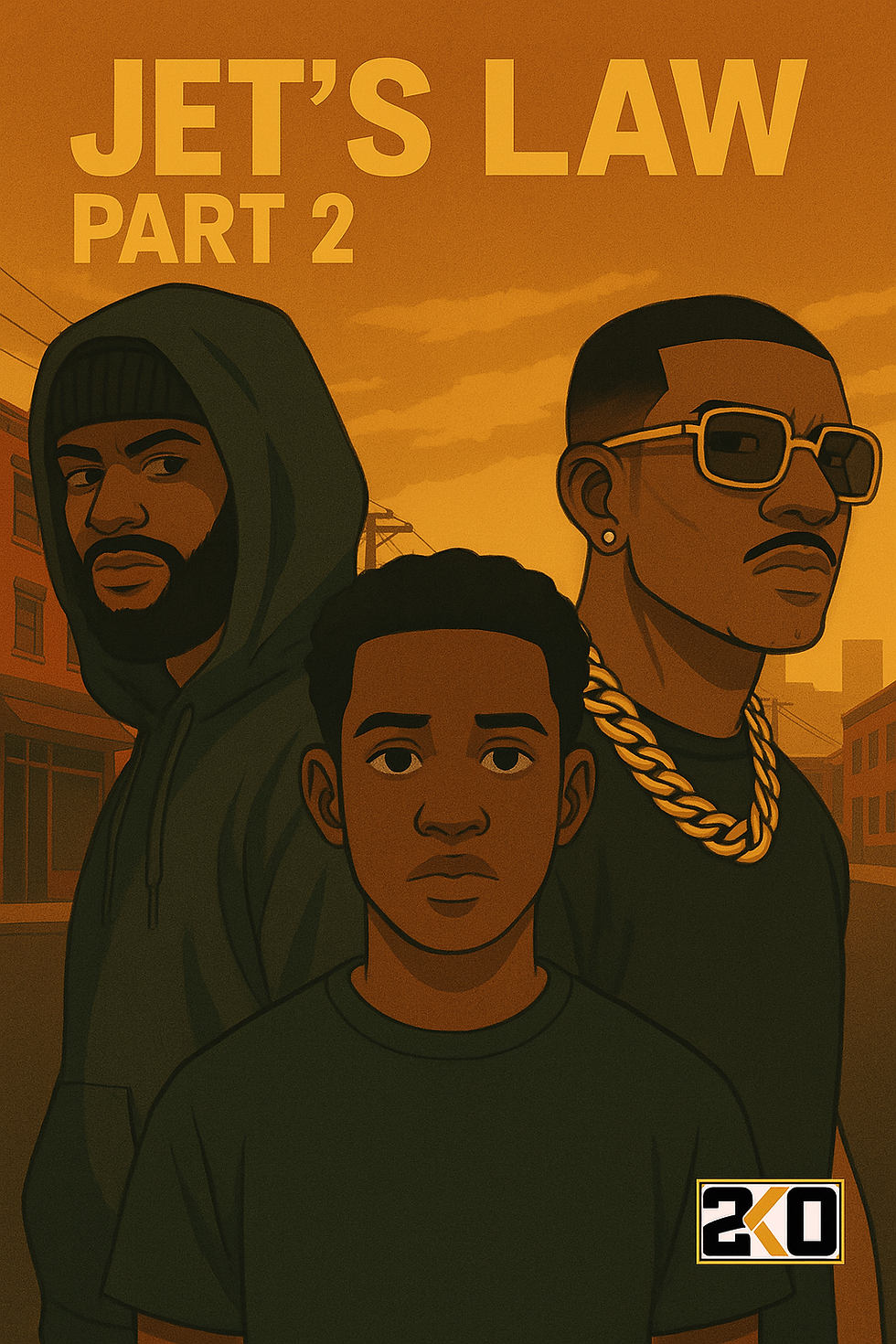
Jet's Law: Protect the block, build the bridge


Carlos Johnson, known on the east side as Officer Jet, wasn’t the type to hide behind his badge.
He earned that nickname growing up—fast on his feet, quick with comebacks, always moving like he had somewhere important to be. Jet came up off 6 Mile and Hoover, raised by his grandmother after his pops dipped and his mother battled addiction. He saw too much too young—sirens at night, memorial candles on corners, and friends who vanished into the system.
But Jet was never built to fold.
Basketball kept him grounded. School gave him glimpses of what life could be. And it was a counselor at his high school—Mr. Tate—who told him something that stuck:
“You got the gift of connection. Don’t waste it.”
Years later, Jet wore a badge—but not to separate himself from the people. He wore it to protect them. To remind them that someone gave a damn.
And more than anything, he was present.
Jet didn’t just patrol neighborhoods. He belonged in them. He remembered kids’ names. Brought donuts to the barbershop on Saturdays. Pulled over not to arrest, but to check on someone’s mental. He didn’t believe in just writing reports—he believed in writing new stories for kids who were already being written off.
That’s why he started The Bridge.
He saw the gap—between school and home, between potential and reality, between childhood and the streets. So he partnered with Detroit PAL and opened an after-school program that hit different.
It wasn’t just a place to hoop—it was a lifeline.
Kids walked into that gym with bookbags and burdens. And slowly, they started to open up. Jet made sure they had more than just a safe space. He brought in tutors. Lined up mentors. There were laptops in the study hall, therapy sessions on Thursdays, and hot meals every night.
He made sure there was something for everyone:
• A girl named Kiana who used to fight every week? Now writing poems and reading them at open mic.
• A boy named Dre who kept getting suspended for skipping class? Now interning at a local sneaker shop through a program Jet set up.
• Even the older kids—once viewed as too far gone—started coming back to volunteer, handing out snacks and rebounding for the younger ones.
Jet didn’t try to be a hero. He just showed up—consistently, with love and accountability.
Still, it wasn’t always love back.
Some people in the city gave him side-eyes—“How you one of us but still a cop?”
Some of his fellow officers questioned him too—“You getting soft, Jet?”
But he never flinched.
“You either build bridges or you watch the next generation drown.”
And Detroit was drowning in too many forgotten kids, too many unsolved problems, too many empty promises.
So Jet kept showing up. He’d work double shifts and still swing by the rec to sweep the gym floor. He’d miss meals to check in on a kid whose mom got evicted. He spent more time in neighborhoods than in the precinct.
One Friday night, he spotted one of his Bridge kids, Treyvon, walking with a group that didn’t feel right. Hoodies up. Energy tense.
Jet didn’t pull his weapon.
He pulled over, cracked the window, and said,
“Yo, Trey… I told your grandma I’d walk you home tonight. Don’t make me a liar.”
That moment? Changed everything.
Jet wasn’t just a cop to these kids.
He was proof that someone could grow up in the trenches and still lead with heart.
Carlos “Officer Jet” Johnson didn’t come to save the city. He came to stand in the gap.
To bridge the past with the future.
To show young Black boys they could be more than their trauma.
To prove that one man, with the right purpose, can light up a whole block.
The Bridge is still open.
Still saving lives.
Still moving with Jet’s rhythm—fast, real, and rooted in love.
Comments